We have all been there.
You were on a roll. You were posting content, answering emails, and feeling like you finally “cracked the code” of being a business owner. And then… life happened. A sick kid, a bad night’s sleep, or just a low-dopamine day.
One missed day turned into two. Two turned into a week.
Now, you’re avoiding your planner because looking at it fills you with dread. The inner critic is loud: “See? I knew you couldn’t keep it up. Why bother trying again?”
For the ADHD entrepreneur, the problem usually isn’t the missed task. It’s the emotional weight we attach to the missed task. We don’t just see an unwritten email; we see evidence of our own inadequacy.
But here is the concept we need to embrace: Missed days don’t erase progress.
Follow-Through Improves When Emotions Are Supported First
We tend to think of follow-through as a discipline problem. We think we need more grit.
Actually, follow-through is often an emotional issue.
When we have unfinished tasks piling up, they carry an emotional charge—usually guilt, shame, embarrassment or anxiety. That heavy feeling makes us want to avoid the task even more. It’s a vicious cycle. We avoid the task to avoid the bad feeling, which makes the task bigger, which creates more bad feelings.
The key to breaking this cycle isn’t to “just do it.” It’s to support the emotion first.
Your system needs to release the emotional weight tied to those unfinished tasks before your brain can clearly see how to solve them. You cannot shame yourself into sustainable success.
The Power of the Gentle Return
Recovery is a skill. Returning is a muscle we have to build.
If you believe that one mistake ruins everything, you will never feel safe enough to try again. But if you believe that “I can come back gently,” you remove the friction of restarting.
ADHD brains are often all-or-nothing. We want a perfect streak or nothing at all. But business—and life—is not linear. It’s messy. The most successful entrepreneurs aren’t the ones who never miss a beat; they are the ones who know how to return to the rhythm without beating themselves up.
How Tapping (EFT) Helps You Reset
When you are staring at that “failure” of a missed week, your body is likely holding onto guilt. This is where Tapping (EFT) shines, it acts as a tool for emotional regulation.
Instead of letting that guilt rot in your stomach or turn into negative self-talk, Tapping helps your system process and release it. When we have unfinished tasks piling up, they carry an emotional charge. That heavy feeling makes us want to avoid the task even more. To break the cycle, we have to support the emotion first.
The Reset: Tapping on “The Guilt of Missing Out” Before you try to force yourself back into your routine, take a moment to clear the emotional fog.
Start by tapping through the points without any words (eyebrow, side of eye, under eye, under nose, chin, collarbone, under arm, top of head). As you tap, relax your body, relax your mind and breathe.
Next, tap through the points again. This time, as you tap on each point, focus on the physical sensation or heaviness of the guilt and imagine letting it go.
You don’t need to try to “fix” the feeling immediately. Just tapping while holding the feeling in your awareness helps neutralize the self-criticism. It signals to your brain that even though you missed a few days, you are safe. You are okay.
By clearing this emotional weight, you clear the path for your executive functions to come back online. You might find that once the guilt is tapped away, the task that feels like a mountain is actually just a small hill, and you can begin again gently.
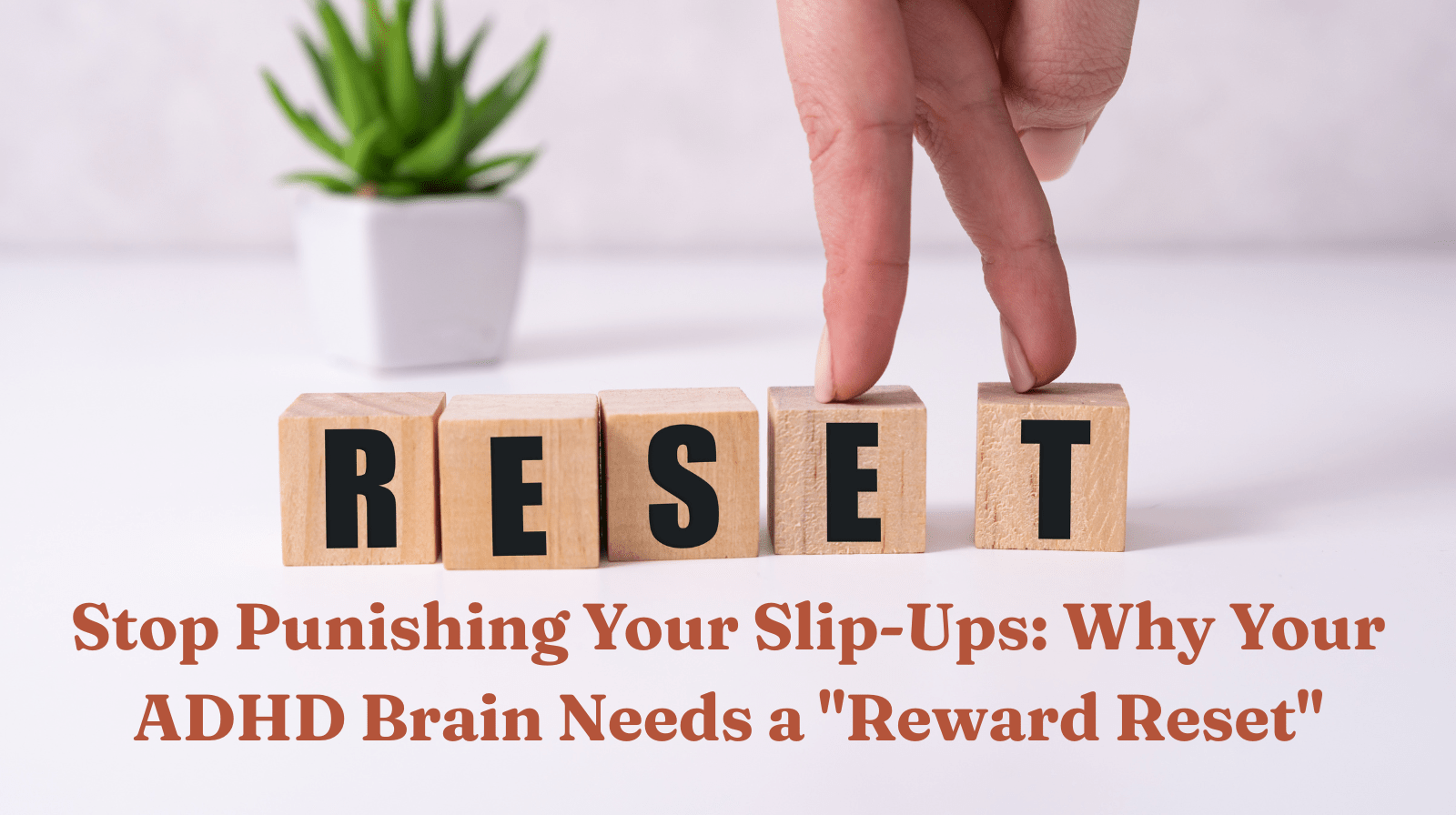
ADHD Hack: The “Reward Yourself”
To help your brain bridge the gap between “falling off” and “getting back on,” try implementing a Reward Yourself strategy.
ADHD brains often operate on a deficit of dopamine, making the climb back to productivity feel like trekking through mud. When we slip up, we tend to lean into “guilt-based motivation,” which is exhausting and unsustainable. By dangling a carrot instead of using the stick, you bypass the shame spiral and jumpstart your momentum.
Instead of waiting until you’ve been “good” for a week to earn a treat, use a reward to initiate the return. This isn’t a trophy for finishing; it’s the fuel to start.
- The Dopamine Deposit: Choose a small, immediate reward that you only get once you complete the first tiny task of your comeback. This could be a favorite snack, 10 minutes on a hobby, or a specific “fun” podcast.
- The “Lower the Bar” Incentive: Make the task so small it feels silly, but pair it with a reward that feels genuinely indulgent.
- The Positive Association: Use the reward to “re-brand” the effort. If coming back feels like a punishment, your brain will resist it. If coming back leads to a reward, the transition becomes desirable.
Why This Works
Getting back on track is rarely about a lack of willpower; it’s about a lack of stimulation and trust. Here is why rewarding yourself is the ultimate “hack” for the ADHD brain:
- Rebuilding Self-Trust: When you slip up, you stop trusting yourself to follow through. By setting a tiny goal and immediately rewarding it, you prove to your brain: “Look, we said we’d do it, we did it, and it felt good.” This micro-win begins to repair your self-trust.
- Dopamine as an On-Ramp: For an ADHD brain, interest and novelty are the primary drivers. A reward provides the hit of dopamine needed to overcome task paralysis, the “stuck” feeling that happens when you’ve been off track for days.
- Breaking the Shame Cycle: Shame is a high-friction emotion. It makes transitions heavy. Shifting the focus to a reward moves you from a state of “I have to fix my mistake” to “I am earning something enjoyable.”
This strategy signals to your brain: “The past is done. We are starting fresh right now.”
You Can Always Begin Again
Self-trust isn’t built on perfection. It is built on the knowledge that no matter how many times you stumble, you can always get back up.
You are building something incredible. Don’t let a few missed steps convince you otherwise. Be gentle with yourself.
If you are looking for a space where your brain is understood and your ambition is supported, I’d love to help you navigate this journey.
Let’s connect:
- Explore the Book: Grab a copy of my book for practical, compassionate strategies for the ADHD mind.
- Discovery Call: Let’s see if we are a good fit. Schedule a chat to discuss what support could look like for your unique business and brain.
- Free Power Hour: Need a body double? Join me every Monday at 11am PT for a free Power Hour. It’s the perfect time to practice your “gentle return.”