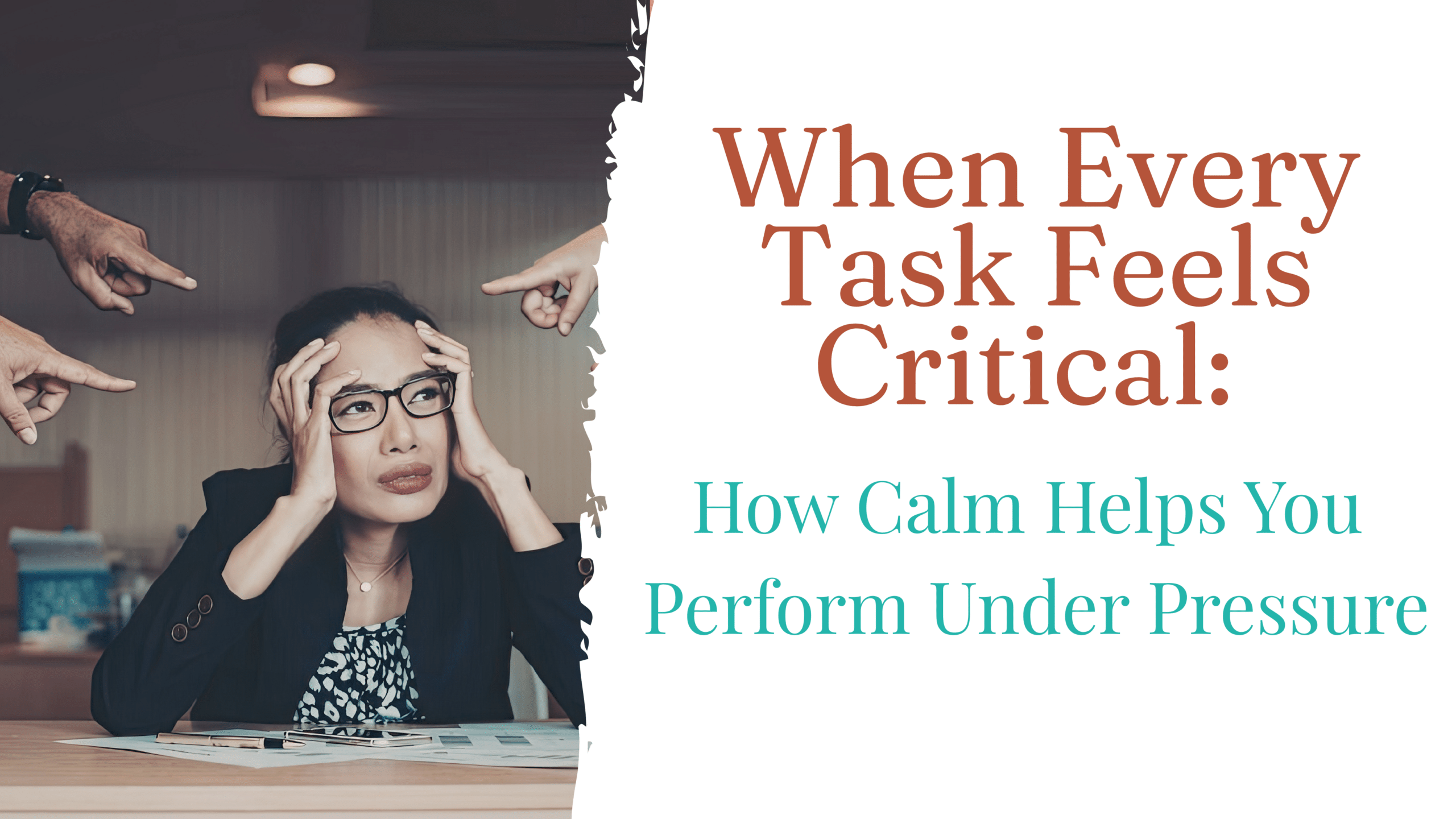

It’s 9:47 on a Tuesday night. The house is finally quiet, the dishwasher is humming, and you just opened your laptop “for ten minutes.” You meant to finish one email. Instead you’re staring at a calendar that says it’s already mid-October, and a little voice in your chest whispers, you are so behind.
Suddenly every tab feels like an emergency. The client email. The holiday plans. The Q4 goals you wrote in January with so much hope. Your heart is racing, your jaw is tight, and you’ve read the same sentence four times.
If that sounds familiar, I want you to hear this first. Nothing is wrong with you. Your body is doing exactly what it was built to do. It just picked the wrong moment.
Why urgency feels like danger
Your nervous system can’t tell the difference between a lion and a looming deadline. When it senses pressure, it flips into survival mode. Stress hormones rise. Breathing gets shallow. Energy moves away from the part of your brain that plans, prioritizes and thinks creatively.
So the very moment you most need clear thinking, your body quietly takes it offline.
That’s why urgency is so convincing. In survival mode, everything looks critical. The email that could wait until Thursday feels as important as the contract due tomorrow. You’re not behind because you’re lazy or disorganized. You feel behind because your brain is scanning for threats, and right now your to-do list looks like one giant threat.
The ADHD layer
If you have ADHD, or suspect you might, Q4 can feel extra loud. Many ADHD brains run on urgency. Deadlines are often what finally get us moving, so we learn to wait for the panic before we start. It works, kind of. But it costs a lot.
Living on adrenaline every week leaves you wired, then wiped out. You finish the thing at 1 a.m., feel relief for about an hour, and then the cycle starts again with the next deadline.
Here’s the gentle truth. You don’t need panic to perform. You can get things done from a calmer place. It might feel unfamiliar at first, and that’s okay.
Five ADHD-friendly hacks for the falling-behind feeling
These are small on purpose. When you’re overwhelmed, small is what actually gets done.
- #27 Make a List. Set a timer for two minutes and write down every single thing that’s swirling in your head. Don’t organize it yet. Getting it onto paper tells your brain it doesn’t have to hold it all anymore.
- #34 Do Just One. Look at that list and pick one thing. Not the whole list, not the top five. Just one. When it’s done, you can choose the next one, and that’s how a mountain turns into steps.
- #6 Schedule It. If it isn’t on your calendar, your ADHD brain may not believe it’s real until it’s an emergency. Give your one thing a specific day and time, and treat it like an appointment with yourself.
- #2 Accountability Partner. Tell a friend, client or colleague what you’re finishing and when. A quick text that says “I’ll send this by Wednesday” creates gentle urgency instead of the 1 a.m. kind.
- #30 Talk About It. Say it out loud: “I’m feeling rushed right now.” Tell a friend, a partner, or even your dog. Research on naming emotions suggests it can take some of their charge away, and it sounds almost too simple, which is exactly why it works on hard days.
Where tapping comes in
Even with the best systems, your body may still be holding that tight, rushed energy. That’s where tapping can help.
EFT, short for Emotional Freedom Techniques, pairs light fingertip tapping on specific points of your face and upper body with honest words about what you’re feeling. Many people describe it as a way of telling their nervous system, “Hey, we’re okay. You can stand down.”
You don’t need to fully believe in it for it to be worth trying. You just need about three minutes.
Here’s how to start:
- Notice the deadline pressure. Where do you feel it? Your chest, your shoulders, your stomach? Rate it from 0 to 10.
- Using two fingers, tap lightly on the side of your hand. Then move through the top of head, eyebrow, side of the eye, under the eye, under the nose, under mouth, collarbone, and under the arm.
- As you tap, keep your focus on that deadline pressure. Let yourself feel it without trying to fix it.
- When you’re ready, take a slow breath and tap through the points again, saying:
“Everything is happening right on time.”
Say it a few times as you move through the points. Then pause, breathe, and check your number again. Even a one-point drop matters. It means your body heard you.
Slowing down is not falling behind
I know it feels backwards. When the clock is ticking, slowing down sounds like the last thing you can afford. But think about the last time you rushed. Did you send the email with the typo? Forget the attachment? Snap at someone you love?
Calm is not the opposite of productive. Calm is what lets you see clearly enough to choose the next right step.
You get to finish this year without running on fumes. You get to meet your deadlines as a whole person, not a frazzled one.
So tonight, before you open that laptop again, put a hand on your chest. Take one slow breath. Tap through the points once. Then pick one thing.
Just one. That’s how you catch up.